
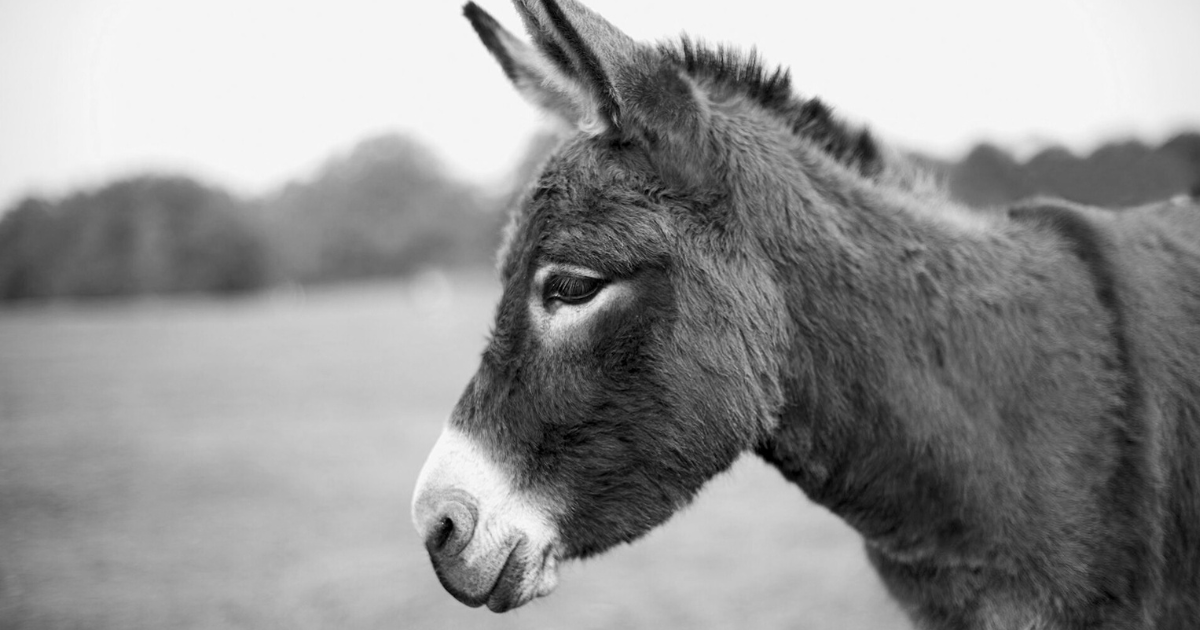
You may have heard about the philosophical paradox of Buridan’s donkey standing midway between a bucket of water on his left and a haystack on his right. He is both thirsty and hungry but is consumed by the dilemma of which need to satisfy first. He looks to his left to see the bucket of water and takes a step towards it in an attempt to drink and quench his thirst, only to glimpse the haystack out of the corner of his eye and remembers that he is also hungry. Instinctively, he turns to the right, stepping towards the hay. However, the glimmer of sunlight reflecting from the water in the bucket catches his attention again and he remembers that he is thirsty too, stopping him in his tracks.
This to-ing and fro-ing continues for a while and, in the end, results in the donkey dying hungry and thirsty because he could not make up his mind.
The donkey is incapable of thinking about the future. If he could, he would have realised that he could drink the water first and then eat the hay. The assumption in this thought experiment is that the donkey will make a rational choice; however, he is incapable of understanding that he could do both sequentially. For him, walking to the bucket to drink meant that he will go hungry, while walking to the haystack to eat meant that he will go thirsty, each scenario taken into isolation, and each thought limited to the short term implications of the individual decision.
How many times have you been in this same situation?
How many times have you embarked on a personal or professional project, tried to pursue multiple directions simultaneously and ended up sabotaging your own projects due to a lack of focus and commitment to one particular direction at a time?
I recently found myself in a similar situation, working on compiling a service portfolio for my teams. The task should have been simple enough. List all the services currently being performed by the team, compile a service description for each, and group them into categories.
However, thirty minutes into this exercise, I was already thinking:
How do we market these services? How much should we charge for each service offering? Are we charging enough? How many resources are needed to provide these services? Could we be more efficient in the way we provide the services? …
Guess what?
Hours into this exercise, I found myself staring blankly at a multiple-column spreadsheet filled with ideas, calculations and descriptions, realising that I hadn’t even scratched the surface of what I wanted to achieve in the first place! Just like the donkey, looking to the left and then to the right, making a step towards the bucket, and then another step in the other direction, towards the haystack, I realised that I wasn’t getting any closer to finalising any of the tasks.
Overthinking leads to “Analysis Paralysis”; The more we think about something, the longer it takes us to take action.
It’s like spending most of your free time browsing movie trailers on Netflix, trying to decide which movie to watch.
Be aware of the following:
Choice overload:
Having too many options or alternatives may lead to indecisiveness. In such cases, I follow three principles:
- use the path of least resistance,
- use social proofing, or
- ask an expert for advice.
Time and again, I would be at a restaurant, looking at the pizza menu. The waiter comes over to the table and says, “Are we ready to order?” and I’m in full panic mode, trying to decide which of the twenty or so mouth-watering pizzas to choose from. I either go with Capricciosa, which is my default go-to pizza (i.e., the path to least resistance), look at reviews/social media posts, or ask the waiter/chef for their recommendation.
Unclear priorities:
Having unclear priorities, or worse, conflicting ones, will derail efforts towards any goal. We tend to lose ourselves in lower priorities because of urgency, difficulty, novelty, other’s opinions and demands.
Understand that the path to a goal is never straight. Priorities change, curveballs are thrown at you, and life simply happens. However, as priorities evolve, you should too. Keep the end goal in sight and set deadlines to challenge yourself towards that goal. Ultimately, what matters is steadily getting one step closer to the goal.
Overanalysis:
Like my unpleasant situation with the service portfolio for my teams, I often find myself lost in a labyrinth of “what ifs” and “hows.”
While there is no harm in thinking big, you should always start small. When action is required, ask, “What is the first step?” and start.
Pursuit of Perfection:
I struggle with this the most. Striving to be my personal best is a timeless aspiration. For a long time, having people point out flaws in my work or thinking process hit my ego hard.
This prompts me to ask, “What am I missing?” or “How can I make this better?” whenever I’m producing something or making a decision.
I am slowly starting to realise that good enough is better than perfect.
Fear of Making the Wrong Choice:
During the company’s end-of-year communication event, the Heads of Departments are invited to give a short presentation of the achievements and challenges faced by their respective departments over the past year in front of all 70+ employees.
Instead of presenting a slideshow with numbers, figures, facts and charts, I decided to take a rather different approach and ride on a funny, then-trending social media post of a Maltese influencer comparing herself with a tiger. My twist was on showcasing my teams’ strengths and challenges using the influencer’s tone and choice of words.
I must have been the last person to submit my presentation for final editing before the event.
“Am I going to make a fool of myself?”, “Should I deliver a more traditional talk?”, “Is the message going to go on top of my colleagues’ heads?”
These were questions going through my mind before I got myself to commit to the decision.
Helping me make the decision was a saying I had heard on a podcast:
“Best case, I achieve what I set out to do; worst case, I learn something”.
My best-case scenario was getting my message across successfully, while the worst-case scenario was enhancing my storytelling and presentation skills while embarrassing myself, which would probably be forgotten after some time — still a win!
Needless to say, in the days, hours, and minutes leading to that speech, my anxiety levels were through the roof. However, the speech turned out to be a success. People laughed at the funny parts of the talk, smiled proudly when I talked about achievements and nodded in agreement when I mentioned the challenges. More importantly, the talk triggered some interesting conversations after the presentations.
Ultimately, learning to focus on one thing at a time and making decisions without overanalysing can save us from becoming like Buridan’s donkey, stuck in a loop of indecision and ultimately getting nowhere. Focus on what you can control, prioritise effectively, and remember that progress, no matter how small, is better than standing still.
Don’t be a donkey!


Leave a Reply