Category: Productivity

  • Stop Building Pedestals: Why Focusing on Monkeys Drives Real Progress

    Stop Building Pedestals: Why Focusing on Monkeys Drives Real Progress

    Last week, I listened to Simon Sinek’s podcast episode featuring Dr. Astro Teller, Google’s Innovation Chief and founder of X, Google’s Moonshot Factory. Dr. Teller referenced the “Monkey on a Pedestal” analogy, which serves as a guiding principle at the Moonshot Factory.

    The concept goes like this:

    Imagine you are tasked with teaching a monkey to recite Shakespeare while standing on a pedestal. The typical response to this difficult problem would be to break it down into smaller, more manageable tasks.

    In this case, you have two major tasks: (1) teach the monkey and (2) build the pedestal.

    It’s clear that teaching the monkey is the more difficult task while building the pedestal is the easier one. Following conventional wisdom, you might think tackling the easier task first makes sense, building the pedestal to gain momentum and mark off some quick wins.

    After all, both tasks demand time, money, and attention.

    Task Completion Bias

    Starting with the easy tasks may seem like a smart way to build momentum. You can check them off your list and feel a sense of accomplishment.

    However, Teller’s analogy cautions against this approach because it encourages procrastination by focusing on non-critical tasks — what psychologists call task completion bias. This bias pushes us toward completing easy, trivial tasks because it gives us the illusion of progress. It’s far more satisfying to tick off several small tasks than to face the reality of working on a complex issue that will take time to resolve.

    I frequently observe this phenomenon in my team during our daily standups and backlog reviews. Our tasks range from simple requests, like resetting passwords, to complex issues, like resolving critical system outages.

    When given the freedom to choose, team members often gravitate toward quick-fix tasks. These allow them to mark off items quickly and feel productive, but the more challenging and urgent issues remain untouched, building up in our queue.

    Sometimes, these critical tasks edge dangerously close to our SLA deadlines.

    It’s not a matter of capability—my team can handle the tough problems—it’s the human instinct to prioritize quantity over quality, the satisfaction of saying, “I closed 10 tickets today” rather than “I’m still working on the big one.” This constant chase for visible progress often comes at the cost of solving the most pressing issues.

    Sunk Cost Bias

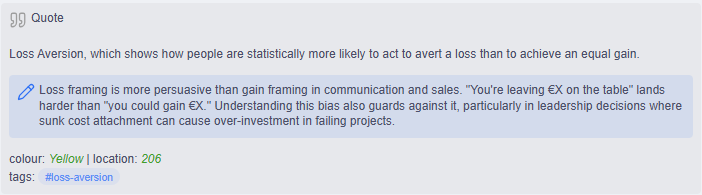
    This behaviour doesn’t stop at task completion bias. It also feeds into what’s known as sunk cost bias. The more time and resources we invest in something, the harder it becomes to walk away — even when it no longer makes sense to keep pushing forward.

    A few years ago, I managed a project for a large-scale implementation. We ran into a significant design flaw in one of the solution’s secondary features. Despite recognising the problem early on, the team had already poured hours into trying to find a workaround. Instead of reevaluating the situation and shifting focus to the critical components of the solution, we kept sinking more time and resources into this secondary issue.

    As we inched closer to exceeding the project’s budgeted hours, the main features were still lagging because so much effort had been diverted to fixing the flawed design. We were trapped by sunk cost bias — the belief that we had already invested so much in the original approach that we had to see it through, despite the fact that it was costing us more time and resources than we could afford. In hindsight, the smarter move would have been to regroup, admit the approach wasn’t working, and pivot earlier. But the time and effort already spent made it hard to change course.

    Dr. Teller’s analogy offers a simple but powerful reminder: in any project, the real success hinges on solving the core problem — teaching the monkey to recite Shakespeare. If you can’t do that, the pedestal is useless. This principle applies to all complex problems: don’t waste time building the pedestals when the real issue remains unresolved.

    In the same project, we eventually managed to deliver on time, but we cut it dangerously close to exceeding the deadline and budget. Looking back, it would have been better to focus on delivering the core features — the “trained monkey” — even if it meant leaving the secondary features unpolished — the “unbuilt pedestal.” We got caught up in secondary issues instead of prioritising the main problem.

    Reverse Salient

    This lesson is directly related to the Reverse Salient concept introduced by Thomas P. Hughes in his book “Networks of Power”.

    Hughes borrows the term from the military, which refers to a part of an advancing force that lags behind and slows progress. In the context of early electrification, Hughes referenced Edison’s struggle to transmit low-voltage direct current over long distances, a hurdle that held back the progress of electrification until alternating current technology was developed.

    In modern terms, reverse salient is what we now call the showstopper, bottleneck or weakest link. The progress of a project or product is limited by its reverse salient — the critical problem holding everything else back.

    MVPs and Agile Development

    Similarly, in Agile development, an MVP (Minimum Viable Product) aims to strip away all non-essential features and focus on solving the key problem as efficiently as possible. By developing an MVP, teams can test core hypotheses, gather feedback, and learn quickly from real users.

    This approach reduces the risk of sinking time and resources into building a fully developed product that may fail and aligns with the Agile philosophy of continuous improvement and iterative development.

    One of the main benefits of Agile development is its flexibility, allowing teams to adapt as they learn more about user needs and market conditions. By releasing an MVP early in the development process, teams can quickly get a product into users’ hands and collect valuable feedback to guide future iterations. This approach fosters a “fail fast and deliver faster” mindset, where the goal is to identify and address issues early on rather than wasting time perfecting features that may not matter in the long run.

    In summary, combining the MVP approach with Agile development empowers teams to stay focused on solving core problems, adapt quickly to feedback, and deliver solutions that meet user needs efficiently — ultimately minimising waste and maximising value.

    Ensuring Project Success

    Through my experience in project management and team leadership, I’ve learned that success often hinges on correctly identifying and addressing the key challenges — the “monkey” in any endeavour. In complex projects, getting caught up in secondary tasks and feeling productive is easy, but the real value comes from solving the hardest problems first.

    That’s why, before diving into any endeavour, performing a reverse salient analysis is crucial. This ensures that the most critical obstacles are identified early and addressed head-on.

    Here are the key lessons I’ve gathered over the years:

    1. If the central challenge (the “showstopper” or training the monkey) is unachievable, it’s better to cut your losses early and pivot to a different approach or project. Pouring more resources into a problem you can’t solve wastes time and energy.
    2. If the showstopper is solvable and relatively easy to implement, then it’s safe to move forward with other tasks (building the pedestals) and continue progress as needed.
    3. If the showstopper is solvable but difficult, then all focus must be directed toward overcoming this challenge before investing time in secondary tasks. Tackling the hardest problems first ensures you aren’t wasting time on work that may later become irrelevant.

    In essence, these experiences have reinforced two critical principles:

    • Always start by working on the unknowns.
    • Focus on solving the real, core problems that will define the success of your project.

    Whether it’s managing a team, providing a service or developing a product, the takeaway is clear: only by confronting the most difficult aspects of a project can you achieve meaningful, lasting progress.

  • Don’t Be A Donkey

    Don’t Be A Donkey

    You may have heard about the philosophical paradox of Buridan’s donkey standing midway between a bucket of water on his left and a haystack on his right. He is both thirsty and hungry but is consumed by the dilemma of which need to satisfy first. He looks to his left to see the bucket of water and takes a step towards it in an attempt to drink and quench his thirst, only to glimpse the haystack out of the corner of his eye and remembers that he is also hungry. Instinctively, he turns to the right, stepping towards the hay. However, the glimmer of sunlight reflecting from the water in the bucket catches his attention again and he remembers that he is thirsty too, stopping him in his tracks.

    This to-ing and fro-ing continues for a while and, in the end, results in the donkey dying hungry and thirsty because he could not make up his mind.

    The donkey is incapable of thinking about the future. If he could, he would have realised that he could drink the water first and then eat the hay. The assumption in this thought experiment is that the donkey will make a rational choice; however, he is incapable of understanding that he could do both sequentially. For him, walking to the bucket to drink meant that he will go hungry, while walking to the haystack to eat meant that he will go thirsty, each scenario taken into isolation, and each thought limited to the short term implications of the individual decision.

    How many times have you been in this same situation?

    How many times have you embarked on a personal or professional project, tried to pursue multiple directions simultaneously and ended up sabotaging your own projects due to a lack of focus and commitment to one particular direction at a time?

    I recently found myself in a similar situation, working on compiling a service portfolio for my teams. The task should have been simple enough. List all the services currently being performed by the team, compile a service description for each, and group them into categories.

    However, thirty minutes into this exercise, I was already thinking:

    How do we market these services? How much should we charge for each service offering? Are we charging enough? How many resources are needed to provide these services? Could we be more efficient in the way we provide the services? …

    Guess what?

    Hours into this exercise, I found myself staring blankly at a multiple-column spreadsheet filled with ideas, calculations and descriptions, realising that I hadn’t even scratched the surface of what I wanted to achieve in the first place! Just like the donkey, looking to the left and then to the right, making a step towards the bucket, and then another step in the other direction, towards the haystack, I realised that I wasn’t getting any closer to finalising any of the tasks.

    Overthinking leads to “Analysis Paralysis”; The more we think about something, the longer it takes us to take action.

    It’s like spending most of your free time browsing movie trailers on Netflix, trying to decide which movie to watch.

    Be aware of the following:

    Choice overload:

    Having too many options or alternatives may lead to indecisiveness. In such cases, I follow three principles:

    1. use the path of least resistance,
    2. use social proofing, or
    3. ask an expert for advice.

    Time and again, I would be at a restaurant, looking at the pizza menu. The waiter comes over to the table and says, “Are we ready to order?” and I’m in full panic mode, trying to decide which of the twenty or so mouth-watering pizzas to choose from. I either go with Capricciosa, which is my default go-to pizza (i.e., the path to least resistance), look at reviews/social media posts, or ask the waiter/chef for their recommendation.

    Unclear priorities:

    Having unclear priorities, or worse, conflicting ones, will derail efforts towards any goal. We tend to lose ourselves in lower priorities because of urgency, difficulty, novelty, other’s opinions and demands.

    Understand that the path to a goal is never straight. Priorities change, curveballs are thrown at you, and life simply happens. However, as priorities evolve, you should too. Keep the end goal in sight and set deadlines to challenge yourself towards that goal. Ultimately, what matters is steadily getting one step closer to the goal.

    Overanalysis:

    Like my unpleasant situation with the service portfolio for my teams, I often find myself lost in a labyrinth of “what ifs” and “hows.”

    While there is no harm in thinking big, you should always start small. When action is required, ask, “What is the first step?” and start.

    Pursuit of Perfection:

    I struggle with this the most. Striving to be my personal best is a timeless aspiration. For a long time, having people point out flaws in my work or thinking process hit my ego hard.

    This prompts me to ask, “What am I missing?” or “How can I make this better?” whenever I’m producing something or making a decision.

    I am slowly starting to realise that good enough is better than perfect.

    Fear of Making the Wrong Choice:

    During the company’s end-of-year communication event, the Heads of Departments are invited to give a short presentation of the achievements and challenges faced by their respective departments over the past year in front of all 70+ employees.

    Instead of presenting a slideshow with numbers, figures, facts and charts, I decided to take a rather different approach and ride on a funny, then-trending social media post of a Maltese influencer comparing herself with a tiger. My twist was on showcasing my teams’ strengths and challenges using the influencer’s tone and choice of words.

    I must have been the last person to submit my presentation for final editing before the event.

    “Am I going to make a fool of myself?”, “Should I deliver a more traditional talk?”, “Is the message going to go on top of my colleagues’ heads?”

    These were questions going through my mind before I got myself to commit to the decision.

    Helping me make the decision was a saying I had heard on a podcast:

    “Best case, I achieve what I set out to do; worst case, I learn something”.

    My best-case scenario was getting my message across successfully, while the worst-case scenario was enhancing my storytelling and presentation skills while embarrassing myself, which would probably be forgotten after some time — still a win!

    Needless to say, in the days, hours, and minutes leading to that speech, my anxiety levels were through the roof. However, the speech turned out to be a success. People laughed at the funny parts of the talk, smiled proudly when I talked about achievements and nodded in agreement when I mentioned the challenges. More importantly, the talk triggered some interesting conversations after the presentations.

    Ultimately, learning to focus on one thing at a time and making decisions without overanalysing can save us from becoming like Buridan’s donkey, stuck in a loop of indecision and ultimately getting nowhere. Focus on what you can control, prioritise effectively, and remember that progress, no matter how small, is better than standing still.

    Don’t be a donkey!