
Welcome to Robert’s Radar; a semi-regular snapshot of what’s bouncing around in my head lately. Ideas, questions, , and quotes that stuck with me. Essays, art, music, tech, and books that are too interesting to leave buried in my notes.
No theme, no fluff. Just the things worth pausing for.
If you’re curious, thoughtful, or just mentally scrolling… this one’s for you.
A Wave 39 Years in The Making
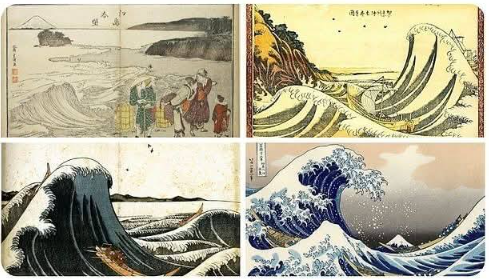
The famous print did not appear out of nowhere. Hokusai drew and redrew waves for almost four decades. Earlier works show restless, slightly awkward seas. Over time the foam, the focus, the colours, the curve, the tension between wave and boat all slowly sharpened. What we now recognise as The Great Wave off Kanagawa is less a moment of genius and more the visible tip of 39 years of refinement.
When he was 33 (1792)

“Springtime in Enoshima,” 1797 (Photo: Wikimedia Commons Public Domain)
The sea is almost decorative here. Beautiful, but still in the background. The wave is there, but it isn’t the main character
When he was 44 (1803)

“View of Honmoku off Kanagawa,” 1803 (Photo: Wikimedia Commons Public Domain)
The water has more movement. The scale and energy are building. You can feel Hokusai getting interested in the drama of the wave itself.
When he was 46 (1805)

“Fast Cargo Boat Battling The Waves,” 1805 (Photo: Wikimedia Commons Public Domain)
Now the wave is a threat. Boats are dwarfed. The foam starts to take on that claw-like shape we recognise, but it is still rough.
When he was 72 (1831)

“The Great Wave off Kanagawa,” ca. 1826-1833 (Photo: Wikimedia Commons Public Domain)
Here is the wave that everyone recognises. The curve is perfect, the foam is alive, the balance between month Fuji in the distance and the boats in the foreground is precise and deliberate. Same subject, completely different level.
I find this comforting. It is easy to compare our work to someone else’s masterpiece and forget that their “finished piece” is standing on an invisible stack of sketches, drafts, abandoned ideas and second attempts.
The lesson I’m taking from Hokusai is simple:
Do the work that is in front of you today, knowing that it might be one more draft on the way to your own “Great Wave”.
Mastery is less about dramatic breakthroughs and more about giving yourself enough repetitions to learn and grow. Hokusai’s wave isn’t one good day in the studio. It’s the accumulated force of decades.
Stoicism in a Nutshell
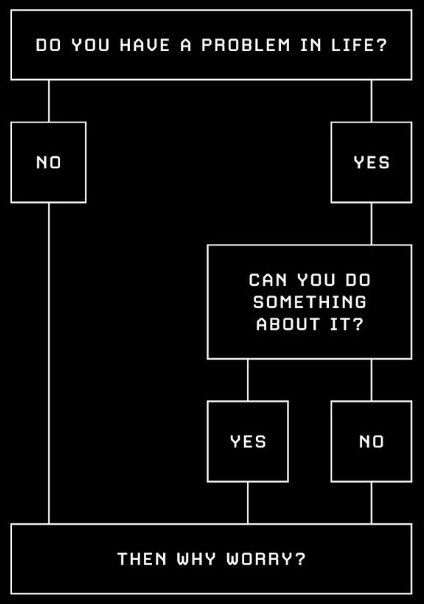
I recently came across the following diagram. It is almost cartoonishly simple, but it maps straight onto the Stoic idea of control.
In Stoicism, every life situation can be categorised into two buckets:
- What I can control (my actions, choices, effort, attention, character)
- What I cannot control (other people’s reactions, outcomes, the past, luck)
He suffers more than necessary, who suffers before it is necessary” — Seneca
If you can change something, act.
If you cannot change it, accept it.
Understand that wasting energy trying to control the uncontrollable causes distress and anxiety. It does not mean pretending everything is fine. It means putting your emotional weight behind what is up to you and loosening your grip on what is not. It means shifting focus from past regrets or future anxieties to the current moment, where actions can be taken.
I like this flowchart as a tiny mental script: a 3-step Stoic debugger for everyday life.
The Four Layers of Information Reality
If you are analytical, well-read, and data-driven, it is easy to assume you are harder to fool.
This piece is a good reminder that every “fact” we encounter has a history:
- Data can be clean but it can also be selectively collected.
- Information processing can look neutral, but it is always optimised for something.
- Narratives can feel balanced, but they always leave things out.
By the time something becomes a belief, the groundwork has already been laid.
Next time you encounter a strong claim, instead of jumping straight to “Is this true?”, question the deeper layers first.
- How was the data gathered?
- Who processed it, and to what end?
- What incentives shaped what was highlighted or ignored?
- What was left out of the story?
Understand how information is transformed before it reaches you.
This is not about becoming cynical. Total scepticism leads to paralysis. Total credulity leads to manipulation. The middle ground is structural awareness: knowing that every layer (data -> processing -> narrative -> belief) leaves fingerprints, and learning to look for them.
The Commodity of Cognition: Why AI is Redefining “Smart”
If machines can calculate faster, code more efficiently, and retrieve information instantly, then technical cognition shifts from differentiator to baseline. The skill does not disappear, it just stops being rare.
So if AI handles the computation, what remains uniquely human?
The danger is not that AI replaces smart people. It is that we keep measuring “smart” with outdated metrics. If you optimise your life solely around test scores, technical credentials, and linear expertise, you might be preparing for a world that no longer exists.
The smartest person in 2035 may not be the fastest problem-solver.
They may be the person who:
- knows which problem is worth solving
- knows when not to optimise
- can anticipate second-order effects
- can tolerate ambiguity
- can judge ethically
As an IT professional and the parent of a six-month-old daughter, I am very aware of how deeply AI is beginning to shape society. I often find myself thinking about what this will mean for her as she grows up in an increasingly AI-driven world.
It is also clear to me that parenting will need to evolve alongside these changes. Just as our parents had to help us navigate the shift into the computer age, we now have a responsibility to equip our children with the mindset and skills they will need to understand, adapt to, and thrive in this new environment: choosing the right problems, thinking beyond the first consequence, and staying human in the middle of all the optimisation.




Leave a Reply